
Project
Women’s Justice Commission: Advancing Gender-Responsive Reform

Overview
The Council on Criminal Justice’s Women’s Justice Commission (WJC) brings together leaders from across the nation to develop actionable, evidence-based recommendations that improve the justice system’s responses to women. Chaired by former U.S. Attorney General Loretta Lynch and guided by a diverse panel of commissioners and expert advisers, the WJC’s goal is to safely reduce the number of women in the justice system while promoting fairness, dignity, and family well-being.
We are honored to contribute to the WJC’s work through the expertise of Erica King, Senior Manager at CEPP.
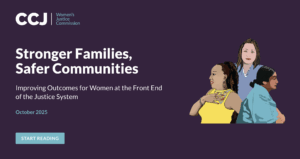 The WJC’s first report, Stronger Families, Safer Communities, presents four recommendations to improve early-stage responses—from arrest through sentencing. A second set of recommendations, to be released in 2026, will focus on the conditions of incarceration, programming in prison, healthcare, and reintegration with families and communities.
Our Approach
CEPP’s involvement with the Women’s Justice Commission reflects our commitment to centering gender and caregiving in system reform. Our approach combines national research, system-level expertise, and direct field experience to help translate recommendations into practice.
For the January 2025 WJC meeting, CEPP’s Erica King and Alison Shames, Director at CEPP, presented on gender-responsive pretrial reform, emphasizing:
- The disproportionate impact of pretrial detention on women—particularly mothers, caregivers, and survivors of trauma
- The need for validated, gender-informed decision frameworks that replace wealth-based detention with evidence-based release and support
- Strategies from CEPP’s Gender Justice Pretrial Toolkit, including participatory approaches that strengthen women’s voice and agency during the pretrial process
- Tools such as judicial bench cards, pretrial services protocols, and participatory resources that help courts and agencies identify and meet the needs of women’s safety and well-being
These presentations built on earlier WJC discussions about women’s pathways to justice involvement, trauma and victimization, and the role of pretrial policy in either mitigating or exacerbating harm.
The Impact
Through our partnership with the WJC and CCJ, CEPP is helping bridge the gap between national research and local implementation, ensuring that reforms are grounded in lived experience and practical application.
Our contributions have:
- Informed the WJC’s policy recommendations on pretrial detention, diversion, and alternatives to incarceration for women and caregivers
- Elevated gender-responsive and trauma-informed frameworks in national policy discussions
- Connected local innovations, like participatory defense, family-centered diversion, and community-based pretrial services, to the WJC’s national reform agenda
- Supported the development of the Stronger Families, Safer Communities report, which now serves as a blueprint for policymakers, practitioners, and advocates seeking to create safer, more equitable justice systems for women and families
As the WJC continues its work through 2026, CEPP remains committed to advancing gender-informed, evidence-based policy change—from national dialogue to jurisdiction-level practice.
Issue Areas
Project Website
Partners
Team


Related Resources
Related Projects

Implementing the Ill...
The Fair Access to Indigent Representation (FAIR) Act establishes Illinois’s first statewide public defender system, marking a historic shift in how t...

Advancing Evidence i...
With support from Arnold Ventures (AV), the Center for Effective Public Policy will partner with parole boards in five states to strengthen parole rel...